
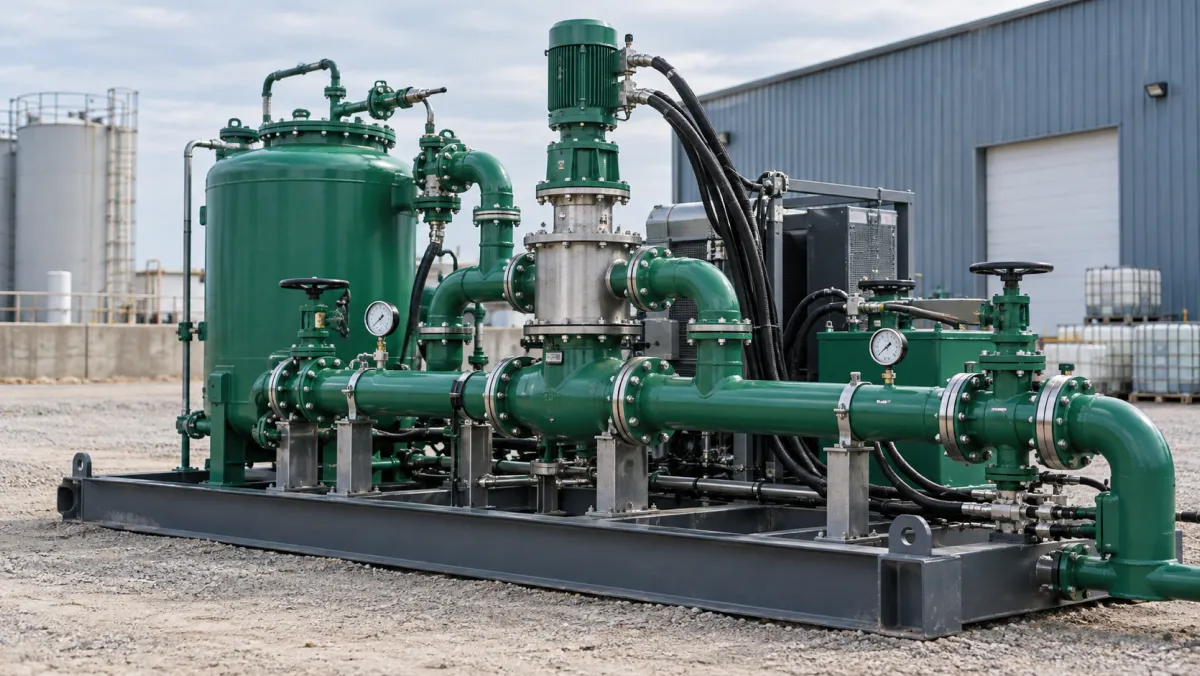
Frac crews judge a mixing system by the screen on the side of the skid. That screen reports what the dosing pumps did, not whether the polymer dispersed. Meter a friction reducer perfectly into water it never fully contacts and the fluid still reaches the perforations without the drag reduction the treatment design assumed. A hydraulic fracturing fluid mixing system succeeds or fails on the energy delivered where dry or emulsified product meets water, and that happens inside the chamber, before any controller reads a value.
Here is what the chemistry demands at each point in the blend, and why extra automation on the mixer itself works against it.
Automated Frac Mixing Describes Two Different Systems
Automation on a frac pad covers two layers that fail in unrelated ways. The control layer meters water, chemicals, and proppant to a recipe through dosing pumps, flow meters, and a PLC. The mixing layer supplies the physical energy that disperses those additives into the stream. Vendors sell both under one word.
A US patent for an automated fracturing system shows the scale of the control layer. It describes sensors and controllers built into the proppant storage, the fluid storage, the additive storage, the hydration unit, the blender, and the pump, with a supervisory layer writing instructions from all of it. Good engineering for control. It also means the fluid recipe depends on dozens of measurement points staying honest through a 20-stage day.
Crews troubleshooting a fluid problem adjust the recipe, because the recipe is what the screen shows them. Dispersion energy never appears on the display.
Friction Reducers Need Full Dispersion Within Seconds
Inverted-emulsion friction reducers arrive as polymer suspended in an oil phase. Before that polymer can cut drag it has to flip out of the emulsion and dissolve into the water, and patent literature on slickwater systems puts the window at several seconds. Past it, full drag reduction never develops during transit down the wellbore.
The failure mode already has a field name. Fisheyes. Patent work on friction reducer stability notes that concentrated polyacrylamide contacting fresh water, including condensate dripping inside a storage tank, forms fisheyes immediately, and those lumps cannot be redispersed. No control loop dissolves a gel lump. It plugs a screen or rides downhole as dead product already on the invoice.
Chemistry keeps getting faster. The salt-tolerant friction reducer documented in SPE 167775 hydrated in roughly 10 seconds in produced water above 300,000 ppm TDS. Mixing energy has to arrive on that timescale, in a single pass, or the product performs below the number on its data sheet.

Guar and Dry Polymer Raise the Energy Requirement Further
Guar needs both time and shear to swell. Frac equipment patents spell out why it belongs at the hydration unit rather than the blender. Added at the blender it gets too little residence time to build viscosity, and the slurry goes downhole thinner than the design called for, carrying proppant it was never conditioned to carry.
Dry product asks more again. SPE work on dry powder friction reducer delivery found that polyacrylamide takes much higher mixing energy than guar to disperse and hydrate properly, which is why dry systems live or die on the wetting stage instead of the metering stage.
Both cases point the same direction. The controller decides how much product enters the stream. The chamber decides whether that product does any work. Adding sensors to the first does nothing for the second.
Where Added Complexity Turns Into Non-Productive Time
Mechanical mixers bring bearings, seals, gearboxes, and drive motors onto the pad, and every one of those parts carries a service interval and a lead time. On a pad running 18 hours a day in caliche dust and 105-degree heat, those parts end up setting the maintenance schedule for the entire fluid system.
Halliburton states the consequence on its own product page: repairs during treatment create delays and raise non-productive time because they require full unit swaps. A blender or hydration unit that needs one component changed mid-job usually gets changed whole, and the operation waits on a truck. Fleet management analysis of pressure pumping operations puts a single failed component at six to twelve hours of stage delay.
Instrumentation fails more quietly. A patent covering automated diagnostics on frac instrumentation notes that a discharge pressure transducer with a built-in calibration routine cannot be calibrated while the equipment runs, because calibrating it interrupts the reading the controls depend on. Drift gets caught between stages, or after the fluid is already downhole.
The crew absorbs the rest. Oxy presented on wellsite automation at the 2026 Strategic Measurement and Allocation conference and described rewriting its exception-based management rules specifically to cut alert fatigue. Once operators learn to swipe past alarms, the automation has stopped working while every light on the dashboard stays green.
How a Simple Hydraulic Fracturing Fluid Mixing System Changes the Equation
The AquaShear mixer drives multiple fluid streams into each other inside a sealed chamber at a nozzle alignment held to 0.1 degrees. No impellers. No bearings. No seals. No gearbox oil to sample.
The collision generates a vortex that emulsifies everything passing through in a single pass. Lab testing shows 99% polymer activation in one second, which puts dispersion inside the window an inverted emulsion needs to flip and a dry polymer needs to wet out. Field blends have finished in 45 minutes where standard systems needed 6 hours, and drilling trials showed 52% less chemical use.
Mixing runs on line pressure already in the system, with no external power and no control logic sitting in the flow path. Installation takes under four hours on standard Victaulic or ANSI flanges, skid mounted or dropped into an existing loop. Maintenance is a 15-minute clean and debris check each quarter, because the only wear item is a nozzle disk. Chambers run from 1 inch to 14 inch, rated to 150 PSIG, with high-temperature polyurethane good to 250°F and 316 stainless with Delrin disks and Viton gaskets for acid or caustic service.
Data logging stays outside the mixer by design. SCADA integration comes through partnership or an additional technology purchase rather than welded to the chamber, so instrumentation stays on your standards and a failed sensor never takes the mixing hardware out of service.

What the Right Hydraulic Fracturing Fluid Mixing System Saves Over a Season
Chemical overspend is the first line on the tally. Crews compensating for incomplete dispersion raise dose rates, and the extra product buys coverage rather than performance. Drilling trials with full single-pass dispersion cut chemical use 52% at the same target concentration.
Then count hours. A mixer with no bearings or seals takes the mid-stage swap off the schedule and the spare parts out of the yard, and it asks for 15 minutes a quarter instead of a standing service interval.
The useful number is total cost across a full completion program: chemical spend, maintenance hours, non-productive time, and the stages that underperformed because polymer never fully hydrated. Most AquaShear customers reach payback inside nine months on chemical savings alone.
Automation belongs where a technician can reach it from a laptop in the data van. The mixing chamber earns its keep by having nothing inside it to fix.
To size a chamber for your rate and fluid system, contact AquaShear at 432-999-8325 or request a quote.