
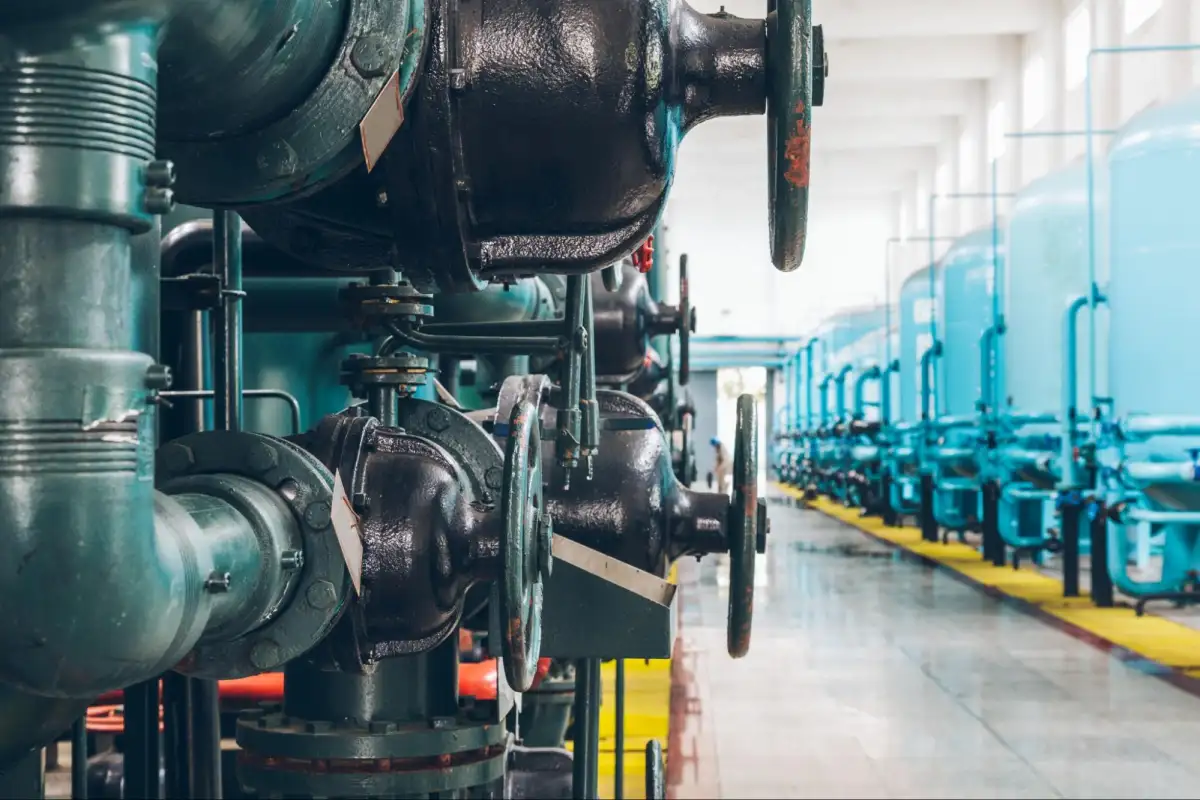
Opposing-jet inline mixers like AquaShear mix chemicals in seconds without blades or motors, while traditional dosing systems offer decades of proven design data.
Every chemical dosing system has two jobs. The first is metering the right amount of chemical. The second is getting that chemical evenly into the water before it reacts. Most plants put their money into the first job (pumps, controllers, flow meters) and treat the second as an afterthought. That’s where a lot of wasted coagulant, chlorine, and polymer comes from.
This comparison looks at two approaches to the mixing side of a chemical dosing system. One is the AquaShear opposing-jet inline mixer, built by Johnson Specialty Tools in Midland, Texas. The other is the group of traditional methods most plants already use, which includes mechanical flash mixers, static mixers, injection quills, and batch tanks for polymer. We compared them on mixing speed, chemical use, energy, maintenance, footprint, and how much verified data stands behind each one.
Which Option Should You Choose? Quick Verdict
Choose an AquaShear inline mixer if you...
- Run polymer activation and want to cut batch aging time from hours to minutes
- Want to get rid of mixer motors, gearboxes, and blade maintenance at the dosing point
- Need a skid that installs in an afternoon on an existing line
- Treat produced water, industrial wastewater, or mining process water where chemical cost is a major line item
Stick with a traditional dosing setup if you...
- Run a potable water plant where state rules or your engineer require NSF/ANSI 61 listed components and published head loss data
- Already have a flash mix basin sized and permitted for your current flows
- Need equipment your operators and local service shops already know
How Do the Two Approaches Compare Side by Side?
| Factor | AquaShear Inline Mixer | Traditional Dosing Systems | Edge |
|---|---|---|---|
| Mixing method | Opposing water jets collide in a chamber | Motor-driven impeller, fixed baffles, or quill injection | Depends on need |
| Moving parts at mix point | None in the mixing chamber | Impeller, shaft, gearbox (flash mixers) | AquaShear |
| Power at mix point | Runs on line pressure | Motor power for flash mixers | AquaShear |
| Reported mix time | Under one second for polymer in lab tests (manufacturer) | Under 30 seconds per typical rapid mix rules | AquaShear |
| Reported chemical savings | 52% in field trials (manufacturer) | Baseline | AquaShear, pending your own trial |
| Published CoV and head loss data | Not posted publicly | Widely published by static mixer makers | Traditional |
| NSF/ANSI 61 listing | Not listed on site, confirm with vendor | Available from many suppliers | Traditional |
| Sizes | 1 inch to 14 inch chambers | Nearly any size | Traditional |
| Maintenance | About 15 minutes of cleanup every three months (manufacturer) | Gearbox oil, seals, bearings, fouled elements | AquaShear |
| Track record | Technology acquired by JST in 2022, founded 2014 | Decades of design standards | Traditional |

What Is a Chemical Dosing System Supposed to Do?
A chemical dosing system meters a set amount of chemical into water and mixes it fully before the reaction window closes, usually within seconds for coagulants.
Coagulants like alum and ferric chloride react fast. If they hit one slice of the flow at high concentration and miss the rest, part of the dose forms floc in the wrong place and part never does its job. Operators often respond by raising the dose, which costs money and can push pH and residuals out of range.
State design rules reflect this. Utah’s drinking water code, for example, requires rapid mix devices to deliver a velocity gradient (G) of at least 750 per second and a mixing time under 30 seconds. It also says the primary coagulant has to go in at the point of maximum turbulence (Utah Admin. Code R309-525-12). That same rule allows mechanical, in-line, or jet mixing devices, which matters for anyone weighing a jet-style mixer like AquaShear.
The metering side has its own problems. Blue-White, a pump maker, lists vapor lock, scaling and clogging, suction lift changes, and calibration drift as common reasons a pump delivers a different dose than its setting (Blue-White). Good mixing can’t fix a bad pump. But poor mixing makes a good pump look bad, because downstream residual samples swing even when the dose is right.
How Does the AquaShear Inline Mixer Work?
AquaShear sends multiple water streams into a chamber from opposite sides, where they collide at precise angles and shear chemicals into the flow without blades.
AquaShear says its nozzles are aligned to within 0.1 degree, and that the collision creates intense turbulence while keeping back pressure low. The company also uses an elliptical venturi eductor on some systems to pull chemical into the stream with suction. The mixing chamber has no blades, shaft, or motor, and the company says it runs on normal line pressure. Complete skid packages can include a pump, so check the full system spec if you’re comparing power draw.
The company reports these results from its own lab tests and field trials (AquaShear).
- 99% polymer activation in under one second in lab testing
- Polymer mixing time cut from about six hours to 45 minutes in a treatment trial
- A 52% reduction in chemical spend in field trials (the About page says “up to 50%”)
- Average payback under nine months
- About 15 minutes of cleanup every three months
Buyers should treat these as manufacturer figures. Some of the trials behind them came from oil and gas drilling, not municipal water. That doesn’t make them wrong, but a side-by-side trial on your own water is the honest way to confirm them.

AquaShear Company Overview
AquaShear is built by Johnson Specialty Tools, a Midland, Texas company founded in 2014 that acquired the AquaShear technology, molds, and patents in 2022.
JST started as an oilfield rental company. When it bought the AquaShear technology, it took the mixer beyond drilling and frac fluid into water treatment, mining, food processing, and pharmaceuticals. In 2025 the company received a Hart Energy Meritorious Engineering Award.
Material options cover most water treatment chemicals.
| Build | Body | Nozzle Disks | Typical Use |
|---|---|---|---|
| Standard | Carbon steel | Polyurethane | Gritty mixes, produced water |
| Food and pharma | 304 stainless | Teflon | Meets FDA and USP Class VI |
| Acid and caustic | 316 stainless | Delrin, with Viton gaskets | Ferric chloride, caustic, acids |
| High temperature | High-temp polyurethane | Fluids up to 250°F |
Mixers come as skids with forklift pockets and an install time the company puts at under four hours, or as inline loops with Victaulic or ANSI flanges and bypass valve options. Chamber sizes run from one inch to 14 inches.
Key strengths
- No impeller, gearbox, or seals at the mixing point
- Very fast polymer activation, which can shrink or remove aging tanks
- Small footprint compared to a flash mix basin
Areas for improvement
- AquaShear doesn’t publish CoV values, head loss curves, or flow ranges on its website, so engineers have to request them
- NSF/ANSI 61 certification isn’t listed on the site, which potable water buyers need to confirm before specifying
- The company has no public case study library yet
What Counts as a Traditional Chemical Dosing System?
Traditional dosing pairs a metering pump with an injection quill, then relies on a mechanical flash mixer, a static mixer, or batch tanks to blend the chemical.
Most plants use some mix of these four.
Injection Quills
Mechanical Flash Mixers
Static Mixers
Batch Tanks for Polymer
Key strengths of traditional systems
- Decades of design standards, textbooks, and operator training
- Published CoV, head loss, and G value data that engineers can plug into specs
- NSF/ANSI 61 listed options from many suppliers
- Parts and service available almost anywhere
Areas for improvement
- Flash mixers draw power continuously and need mechanical upkeep
- Static mixers add permanent head loss and can foul
- Quills alone often leave chemical unevenly spread
- Polymer batch tanks take up floor space and hours of time
Which Option Mixes Chemicals Faster and More Evenly?
AquaShear reports sub-second polymer activation, while traditional flash and static mixers are designed and proven to mix coagulants within the 30-second window.
For coagulants in a municipal plant, a well-designed flash mixer or static mixer already meets the rules. The gain from switching is less about passing a standard and more about running the dose lower once mixing gets more even.
Polymer is a different story. If your plant ages polymer for hours, an inline activation unit that works in seconds can free up tank capacity and stop the waste that comes from overfeeding half-activated polymer. AquaShear’s reported drop from six hours to 45 minutes is the kind of change operators notice right away.
Verdict: Traditional systems have the verified data for coagulant mixing. AquaShear has the stronger case for polymer activation and for any process where mixing speed limits throughput.
Which Option Costs Less to Own?
AquaShear can lower operating cost through reduced chemical use and minimal maintenance, while traditional systems often cost less upfront because many plants already own them.
Chemical spend is usually the biggest number. A plant spending $200,000 a year on coagulant and polymer would save $20,000 with even a 10% dose reduction. If the reported 52% held on your water, the payback math gets short fast, which is where AquaShear’s claimed under-nine-month payback comes from. The company offers an ROI calculator on its site for running your own numbers.
Traditional systems win when the equipment is already paid for and working. Ripping out a functioning flash mixer to save a little power rarely pencils out. The better fit for AquaShear is a new build, an expansion, a line where the old mixer is failing, or a polymer system that’s eating floor space.
Verdict: Run a trial and compare chemical use per million gallons. That one number decides the cost question better than any brochure.

Which Option Needs Less Maintenance?
AquaShear reports about 15 minutes of cleanup every three months, while mechanical flash mixers need routine gearbox, seal, and bearing service.
A flash mixer has the same parts list as any motor-driven machine. Oil changes, seal replacements, bearing wear, and the occasional shaft alignment. Static mixers have no moving parts either, but elements can build up scale or polymer and pulling a section of pipe to clean them is real labor.
AquaShear’s nozzle disks are the wear item. The company says polyurethane disks hold up well in gritty water and that routine cleanup takes about 15 minutes per quarter. The bypass valve option lets operators service the unit without shutting down the line.
Verdict: Edge to AquaShear on routine upkeep, with the caveat that long-term wear data from municipal plants is still limited.
Which Option Is Easier to Specify and Approve?
Traditional dosing systems are easier to get through engineering review because their CoV, head loss, and certification data is published and familiar to regulators.
This is the biggest hurdle for newer mixing technology. A consulting engineer writing a spec for a public water plant wants a head loss curve at design flow, a CoV or G value, and an NSF/ANSI 61 listing for anything touching drinking water. Static mixer makers publish this as standard practice.
AquaShear’s site mentions CFD modeling but doesn’t post the numbers. That doesn’t mean the data doesn’t exist. It means buyers need to ask for it early, along with the datasheet and any third-party test reports. Industrial and wastewater users with fewer approval layers will find this step much easier.
Verdict: Edge to traditional systems for municipal potable work. For industrial and wastewater plants, the gap is small.
How We Evaluated These Options
This comparison used manufacturer documentation, state design code, and published vendor engineering data, weighing each option on six factors buyers raise most often.
The six factors were mixing speed and evenness, chemical use, energy, maintenance, footprint, and the depth of verified performance data. AquaShear figures come from the company’s water treatment, technology, and About pages as of October 2026, and we’ve labeled them as manufacturer-reported. Traditional system benchmarks come from Utah’s drinking water code, Asahi/America’s injection quill guidance, NOV Kenics static mixer literature, and Blue-White’s dosing and flow verification guidance. No company paid for placement in the scoring.
Full Comparison Table
| Option | Key USP | Pros | Cons | Best For |
|---|---|---|---|---|
| AquaShear Inline Mixer | Opposing-jet mixing with no blades or motor | Sub-second polymer activation (reported), low upkeep, small skid, multiple material builds | Limited public test data, NSF/ANSI 61 not listed online, newer track record | Polymer activation, industrial and produced water, wastewater, chemical-heavy plants |
| Mechanical Flash Mixer | Proven G value control for coagulants | Meets rapid mix rules, well understood | Continuous power, gearbox and seal upkeep, needs a basin | Existing municipal plants with permitted basins |
| Static Mixer | Fixed elements, published CoV | No moving parts, strong published data | Permanent head loss, fouling, weaker at low flow | Steady-flow pipelines with clean chemicals |
| Injection Quill Only | Cheapest way to place chemical | Low cost, simple install | Relies on pipe turbulence, tips scale | Small systems with long pipe runs before use |
| Polymer Batch Tanks | Familiar polymer prep | Simple to operate | Hours of aging, floor space, overfeeding risk | Plants with spare tank space and low polymer use |
Our Recommendation
AquaShear is the better choice when...
- Polymer aging tanks are slowing down your process or taking up space you need
- Chemical spend is high enough that a 10% to 50% cut would move your budget
- You’re adding a new dosing point and don’t want another motor to maintain
- You’re treating produced water, mining water, or industrial wastewater
A traditional system is the better choice when...
- Your flash mixer or static mixer already works and is paid off
- A consulting engineer needs NSF/ANSI 61 listings and published head loss data to sign off
- Your operators and local service shops only support conventional equipment
Frequently Asked Questions
What is a chemical dosing system in water treatment?
A chemical dosing system meters chemicals like coagulant, chlorine, or polymer into water using pumps and controls, then mixes them so they react evenly.
A complete system includes a storage tank, metering pump, injection point, mixer, and usually a flow meter or controller that paces the dose to plant flow.
Is an inline mixer better than a flash mixer?
An inline mixer saves space and power, while a flash mixer offers well-documented G values. The better choice depends on plant flow, chemical, and approval needs.
Utah’s code, for example, allows mechanical, in-line, or jet mixing devices as long as they reach the required mixing intensity and time.
How much chemical can a better mixer save?
Savings vary by water and chemical. AquaShear reports 52% in field trials, but plants should confirm results with their own side-by-side test.
Even small improvements add up. A 10% cut on a six-figure chemical budget pays for most mixer upgrades within a year or two.
Does AquaShear have moving parts?
The AquaShear mixing chamber has no blades, impellers, or motor. It uses water pressure and colliding jets, though complete skid packages may include a pump.
The wear items are the nozzle disks, which come in polyurethane, Teflon, or Delrin depending on the chemical.
Can AquaShear be used for drinking water?
AquaShear lists water treatment, chlorine mixing, and pH control as applications. Potable water buyers should confirm NSF/ANSI 61 certification with the company before specifying.
For wastewater and industrial water, certification requirements are usually lighter.
What size inline mixer do I need?
AquaShear chambers range from one inch to 14 inches. Sizing depends on flow rate, chemical, and available line pressure, so request a sizing review first.
Have your design flow, minimum flow, line pressure, and chemical list ready when you call.
